• Home
  • Programs
    • Give A Bus Ride
    • Advocacy >
      • Proposal: Iowa City Transit Commission
  • Research
    • Community Survey - 2015
    • Community Survey - 2015: Updates
    • Employer Survey - 2018
    • Analysis of TOD Opportunities in Iowa City, Coralville, and North Liberty - 2025
  • Maps
  • Blog
  • About us
    • Staff
    • Annual Reports
  • Opportunities
    • Internships
    • Volunteer
    • Steering Committee
  • Join CTC
  • Contact US
  • Donate
  • Home
  • Programs
    • Give A Bus Ride
    • Advocacy >
      • Proposal: Iowa City Transit Commission
  • Research
    • Community Survey - 2015
    • Community Survey - 2015: Updates
    • Employer Survey - 2018
    • Analysis of TOD Opportunities in Iowa City, Coralville, and North Liberty - 2025
  • Maps
  • Blog
  • About us
    • Staff
    • Annual Reports
  • Opportunities
    • Internships
    • Volunteer
    • Steering Committee
  • Join CTC
  • Contact US
  • Donate

BLOG

Letter to Iowa City City Council

10/6/2020

0 Comments

 
On Tuesday, October 6th at the Iowa City City Council Work Session, the Iowa City Area Transit Study will be presenting possible changes to our community's transportation. We have been educating city council members on the issues experienced by those who use the bus and hope that they use this opportunity to do things right and improve transit for underserved communities. Read the letter we sent to council expressing our concerns:
Dear Iowa City Council,

As you listen to the recommendations presented by the transit study and prepare to finalize transit system changes, we again encourage you to improve the system for those currently in need of the service. This is a service that should be accessible to all, and yet second-shift, low-income, and disabled community members are being left behind. 

On October 1st, CTC held a Community Meeting on Improving Transit in which several community members voiced their concerns. One commuter anecdote detailed the 45-minute bus commute that necessitates them arriving over 30 minutes early to work versus a 10-minute car commute. Another bus rider explained how she couldn't afford the fare when she had to switch between Iowa City and Coralville buses, which requires some commuters to buy at least two passes. 

​Every day, workers are forced to walk home in the middle of the night because there's no service available when they get off work. Our community needs Sunday service and night service. We are asking for you to get creative: can we provide a taxi voucher for service until midnight? What routes would make the most sense to run on Sundays? What funding can the city apply for to provide these basic services? Are there public-private partnership opportunities with employers in our community? 

​If the funding does not currently exist, we need to find it. We also request that you eliminate the current policy that prevents those with disabled passes from riding during peak times; this policy is extremely discriminatory as it limits the independence of those with such passes. 


Thank you,
Community Transportation Committee

We will be having a watch party to listen to the recommendations made by the Transit Study and discuss the impact they may have on the community. This meeting is at 5:00pm. Please join at the following link: https://uiowa.zoom.us/j/91662829268
0 Comments

Iowa City Area Transit Study Scenarios - By Andrew Jansen

2/17/2020

0 Comments

 
Picture
Current Iowa City Transit System Map
The Iowa City Area Transit Study Survey offers the opportunity for residents to give their opinion on  preferred aspects of three scenarios for Iowa City area bus routes. These changes aim to improve the speed, reliability, and frequency of the buses. The Transit Study scope is limited by the constraint that it must improve the bus system without any change in the allocated budget for the buses. Because of this, none of the scenarios expand the bus system without consolidating routes to make up the difference in the budget. Depicted below are the current routes which the Transit Study aims to improve. 

View a Side-by Side Comparison of the Transit Scenarios.​
Picture
Scenario 1


Scenario 1, depicted above, aims to increase the frequency of popular routes, to simplify the route network, and to consolidate routes along major commercial and residential corridors. This consolidation centers mainly around downtown Iowa City, with only two high-frequency stops placed outside it at Towncrest and Oakcrest. This placement would shorten the reach of the transit system and may disadvantage Coralville and North Liberty residents.

This scenario has the advantage of favoring the Iowa River Landing portion of Coralville, which holds many businesses and apartments, and promises to attract more riders to the system.  Another advantage is the quicker run-times. A major complaint among residents is the inconsistency and infrequency of the bus system. If one bus is missed, a rider could be delayed 30 minutes to an hour, which greatly discourages residents who need transportation to their jobs, and to whom delay could mean unemployment. 

In this scenario, the Coralville route is broken up into six routes, which may improve the run-time of buses in Coralville, where the issue of delay is at its greatest. But the scenario does this at the cost of lessening the reach of the Coralville transit, and compelling riders to walk farther to catch the bus. Whether this trade-off is worth it will depend on the target ridership. The faster run-times will be better for workers, but the shorter reach will be worse for the elderly. If the city can offset this disadvantage with its on-call service, the trade-off may very well pay off.​
Picture
Scenario 2
Scenario 2, depicted above, is a more moderate version of the first scenario, and so shares many of its advantages and disadvantages. However, Scenario 2 does not include the projected 15-minute run-times that Scenario 1 boasts, except for in a few CAMBUS routes. Shortening the CAMBUS run-times would be advantageous since CAMBUS is fare-free and attracts a lot of riders. This scenario lacks the quicker run-time to the Iowa River Landing however it connects the route downtown, which may help workers in the Iowa River Landing area, particularly hotel employees.
Picture
Scenario 3
Scenario 3, depicted above, expands service in the evening and on weekends. Based on CTC’s research on the transit needs of low-income workers, service in the evening and on weekends is acutely needed, and this scenario would be the most attractive to people who already ride the bus. This scenario also has the advantage of being able to gather data on the rates of ridership at times that the bus does not currently service, which would help the city ascertain the demand for evening and weekend services.

For commercial areas, weekends are especially important to service, since workers in the service industry work seven days a week (and often late nights). For this reason, evening and weekend access to the Coralville mall is especially important, as well as service to the hospital where shifts also extend late at night. This scenario also provides easier access to industrial parks in the southeast of town by consolidating the Broadway and Mall routes, benefiting low-income workers, which is one of the major targets for a public transportation system.
​

While leaving most of the system unchanged may prevent reducing coverage in some areas, this scenario leaves the problem of speed, reliability, and frequency unsolved. And as the general trend of transit ridership in Johnson County has been decreasing, this may not be a satisfactory solution to a city that wants to turn around these losses.

​
0 Comments

Iowa City Climate Action through Public Transit Improvements

1/26/2020

0 Comments

 
By: Jacob Atherton
Picture
The City of Iowa City has set an ambitious goal to lower our total greenhouse gas emissions by 80% by 2050, compared to emissions data measured in 2005. We as Iowa City residents now have 30 years to contribute to the ongoing progress to reduce emissions and lead as an example for other cities around the United States who see the need to do the same. Iowa City has the potential to demonstrate how a community can collectively adapt to the effects of climate change while empowering all residents to get actively involved, be heard, and benefit from and contribute towards efforts for a better future.
​

Emissions associated with transportation are Iowa City’s second-highest pollution source, following energy consumption from buildings. According to the Iowa City Climate Action and Adaptation Plan, roughly 2/3 of working people in Iowa City commute via their own personal car, and the majority of those who do so travel alone. There is quite a lot of potential to reduce our emissions by changing our transportation and mobility habits.
​

Cars release their most toxic pollution within their first few minutes of operation, prior to reaching their optimum operating temperature. Because of this, when using a car to make a short distance, a single destination trip of two miles or less, higher levels of pollutants will be released per mile traveled compared to a car that is making a longer trip. Those quick runs to the store to grab a few items or a short commute to work really do add up over time, even if they don’t consume a lot of gasoline at the time.
​

Vehicle travel is expected to continue to grow over time as Iowa City expands. More people, more cars, more short trips, and more time spent idling at stoplights. As informed citizens, we have a responsibility to shift our short errand trips and commutes from personal vehicle travel to public transit, cycling, and walking when possible. Iowa City, the University of Iowa, and Coralville will be presenting transit service improvements for each of their systems on January 28th, 29th, and 30th.

​In order for improvements such as fare reduction, fare elimination, the addition of bus stops, route changes, or service hours to be effective tools to reduce emissions while improving mobility for those who need it most, public feedback is crucial. Proposed improvements with clear public support are much, much more likely to be funded and implemented later this year. Participants of these public transit meetings will have the opportunity to complete a survey regarding these improvements and have their voices heard by working together with their community to reinforce ideas that can actually make an impact.

0 Comments

Community Survey Results

1/6/2016

0 Comments

 
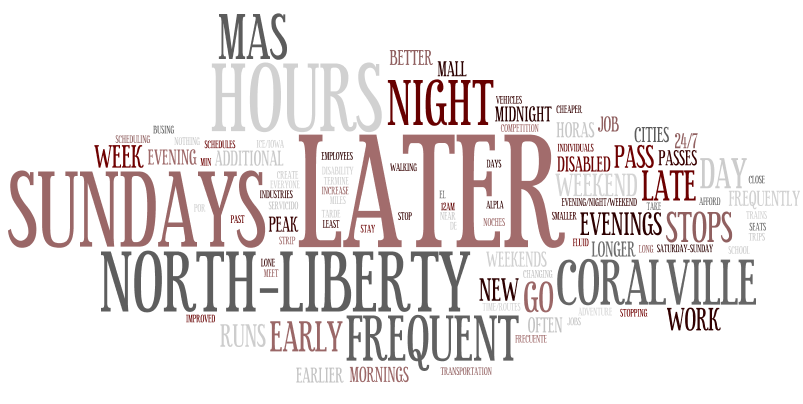
Results are in! We are very excited to present the results of our survey after several months of hard work. We would like to thank everybody who was involved with collecting the data and supporting the effort! Please take a look and offer any feedback you have to offer.

​View the Results!
Picture
0 Comments

Gift Wrapping Fundraiser!

11/28/2015

0 Comments

 
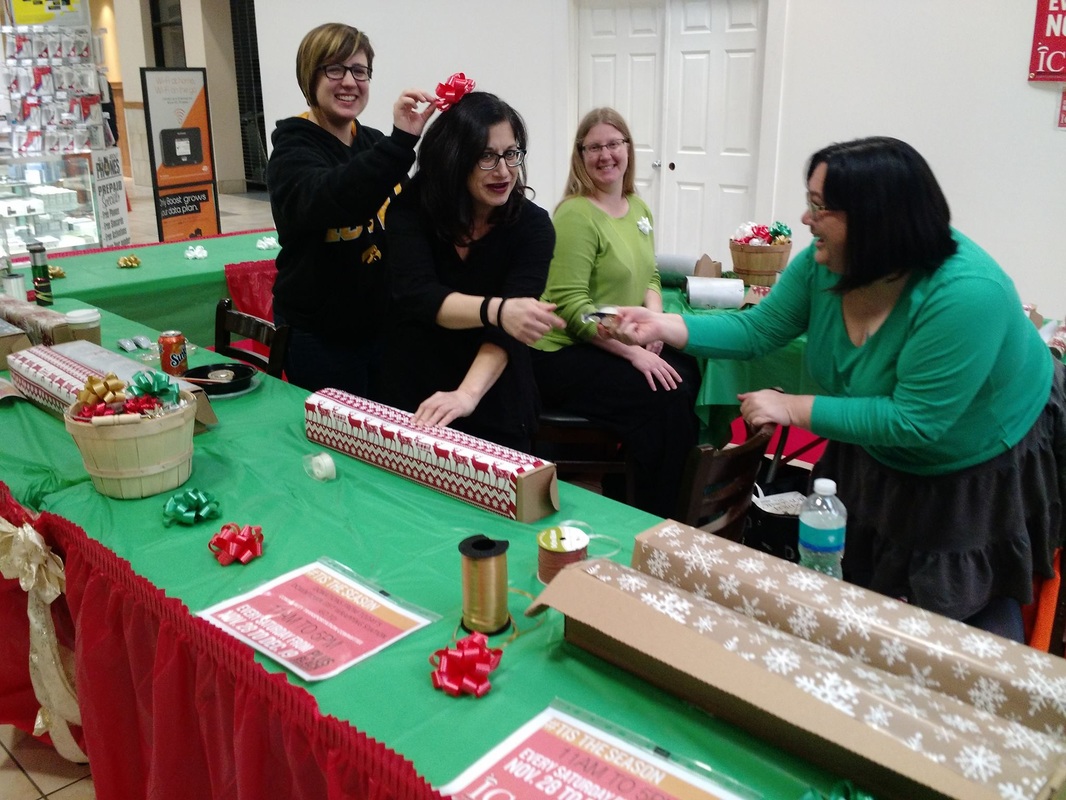
If you're in a shopping mood today between 10:30 am and 5:00 pm, drop by the Old Capital Mall in downtown Iowa City and get your gift wrapped for FREE! The Community Transportation Committee team will be wrapping presents to raise money for bus tickets for people in need and for advocacy for inclusive transportation. Bus tickets will be distributed through local nonprofits. You can give us tips for gift wrapping or you can drop donations in our jar. The fundraiser is sponsored by the Iowa City Downtown District.
Picture
0 Comments
Forward>>

    Archives

    December 2025
    September 2025
    July 2023
    April 2021
    February 2021
    January 2021
    December 2020
    November 2020
    October 2020
    February 2020
    January 2020
    January 2016
    November 2015

    Categories

    All

    RSS Feed

Picture

Community Transportation Committee
CTC is a 501c(3) EIN 
82-1532723 
Johnson County, Iowa
CTC is a nonprofit organization and is not affiliated with the City of Iowa City or IC, Coralville, or Johnson County Transit Systems


Telephone

916-599-9399

Email

[email protected]